A closer look at how clients trained, what changed, and what their before/after qEEG brain maps showed.
These are real client experiences, shared for education. First names are pseudonyms, and details are simplified for privacy. Each person trained with a personalized plan built from their qEEG brain map.
Neurofeedback at New York Wellness Group is a non-medical wellness and brain-training service. It is not a treatment for any disease, and these stories are not a promise of results — everyone responds differently. Where someone had a medical condition, they continued working with their own licensed providers, and neurofeedback was used to support brain self-regulation alongside that care.
A drug-free path back to deep, consistent sleep.
In her early 40s, Molly came to us after years of severe insomnia — some nights she averaged well under an hour of sleep. She also carried a lot of daily tension. She wanted a non-medical way to help her brain settle into healthier sleep rhythms.
Training focused on calming over-arousal and supporting the brain states associated with restful sleep, using an eyes-closed protocol over a 4-month cycle. Her plan was guided by her qEEG brain map and adjusted as she progressed.
“I slept 8.5 hours the night after my very first session. By the end, my watch was tracking my sleep in the high 90s.”
— Molly
Steadier focus and calm for a national-team athlete.
Leah is a U.S. national-team athlete who came to us with performance anxiety, low mood, brain fog, and disrupted sleep — and a heavy competition and travel schedule that made consistency hard.
We used database-guided Z-Score training tailored to her qEEG, fitting 24 sessions around her competition calendar over six months. The goal was steadier emotional regulation, sharper focus, and better recovery.
“By the end I had much better emotion regulation, no more anxiety, and deeper sleep with more dreams.”
— Leah
Rebuilding energy, focus, and sleep after a long illness.
A young woman, Christie came to us with low energy, persistent brain fog, poor sleep, and anxiety that lingered for years after a viral illness. She was under the care of her medical team and wanted a non-medical way to support her energy, focus, and overall regulation.
Her plan began with peripheral, eyes-closed training to help calm the nervous system, then shifted to a two-channel balancing protocol over a 24-session cycle — all guided by her qEEG and her week-to-week response.
“I have more energy, a better mood, and I’m sleeping well again.”
— Christie
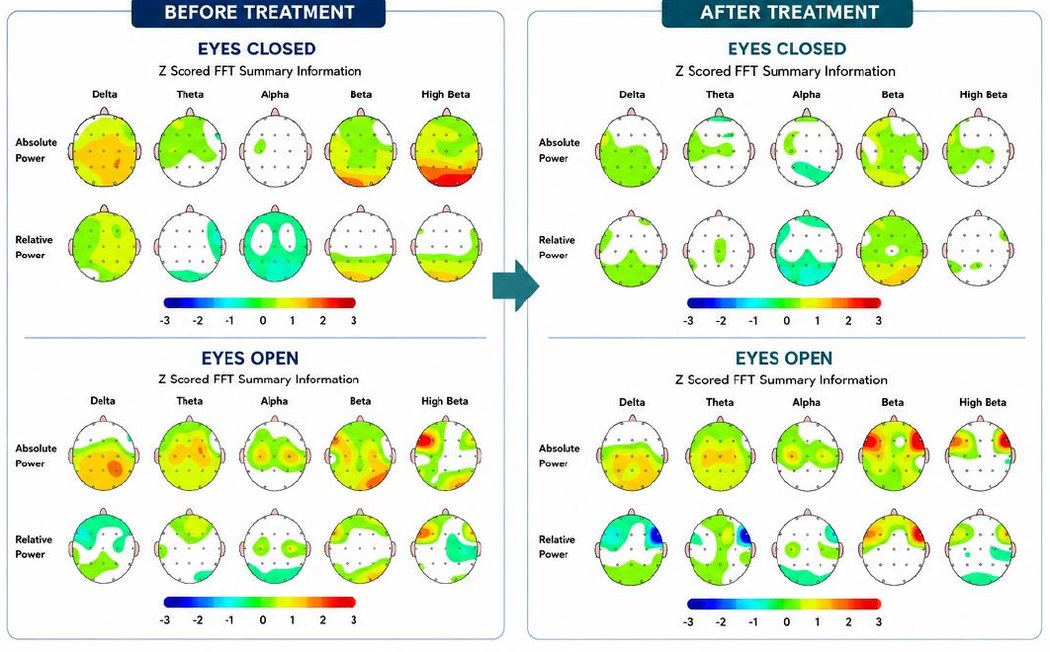
Before and after qEEG (eyes closed and eyes open). Warmer reds move toward a more balanced green range. Illustrative; individual results vary.
Sharper focus, better memory, and a return to feeling like herself.
In her 50s and about nine months after a stroke, Stella was continuing her occupational therapy when she came to us. She wanted to support focus, memory, sleep, and fine-motor coordination as a complement to her ongoing medical care.
Her cycle began with SMR training to support calm, steady focus, then moved to Z-Score training across parietal and occipital regions, finishing with reinforcement — 24 sessions of 30 minutes, twice a week, all guided by her brain map.
“My focus and memory improved so much, and my sleep got better too. Honestly, I felt like myself again.”
— Stella
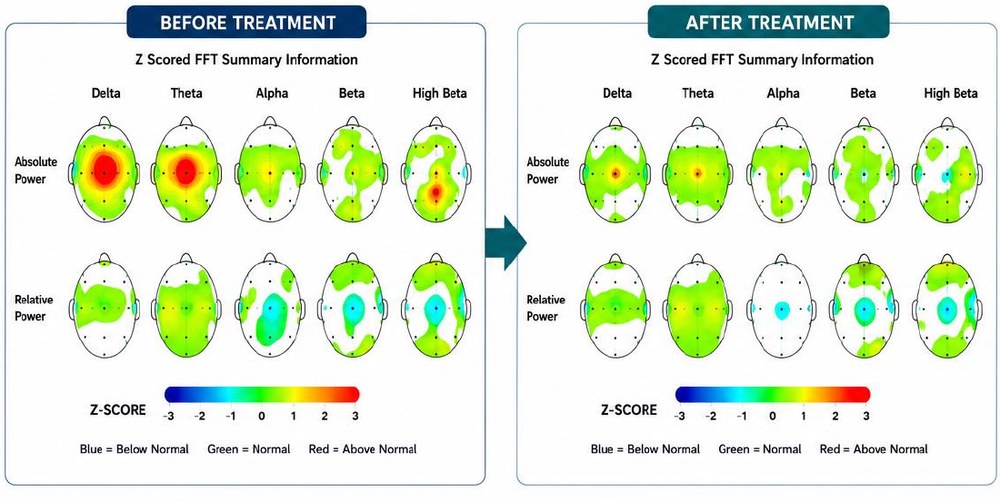
Before and after qEEG brain map. Excess activity (warm colors) in the midline moves toward a balanced (green) range. Illustrative; individual results vary.
Supporting calm, self-awareness, and learning for a young adult.
Jay is a young adult on the autism spectrum. His family wanted a drug-free way to support attention, calm, and self-regulation — and, over time, reading and learning. He was not on medication and continued his usual routines throughout.
Training began by targeting the sensory-motor region to support steadier self-regulation, starting daily and easing to weekly maintenance as he progressed, with the focus gradually shifting toward attention and learning. Everything was guided by his qEEG.
“He’s making progress every week. He’s calmer, more aware, and joining conversations he used to stay out of.”
— Jay’s parent
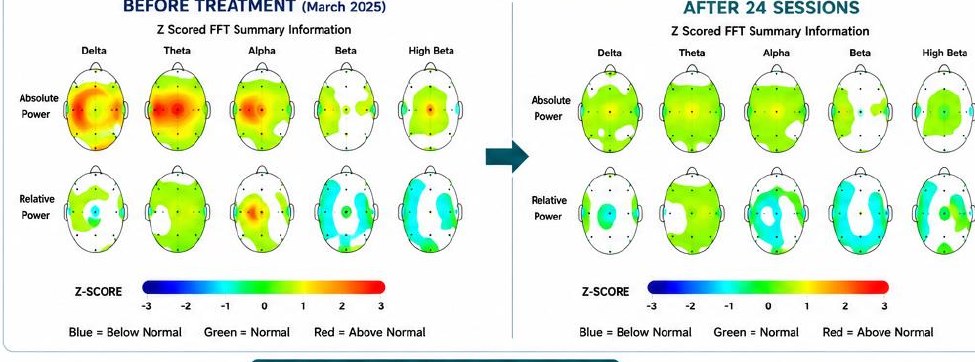
Before and after qEEG (eyes closed). Excess slow-wave activity moves toward a more balanced range. Illustrative; individual results vary.
Every plan starts with a qEEG brain map. We’ll show you your starting point and map out the right next step together.
Book Your qEEG Brain MapThese case studies are shared for educational purposes and describe individual client experiences. Names are pseudonyms. Neurofeedback and qEEG brain mapping at New York Wellness Group are non-medical wellness and brain-training services — they are not a medical or psychiatric treatment, are not intended to diagnose, treat, cure, or prevent any disease, and have not been evaluated by the FDA. Results vary from person to person and are not guaranteed. Please consult a licensed healthcare provider for medical concerns, and never stop or change prescribed treatment without their guidance.